
Utah national parks have a $350M maintenance backlog. The Trump admin isn’t helping.
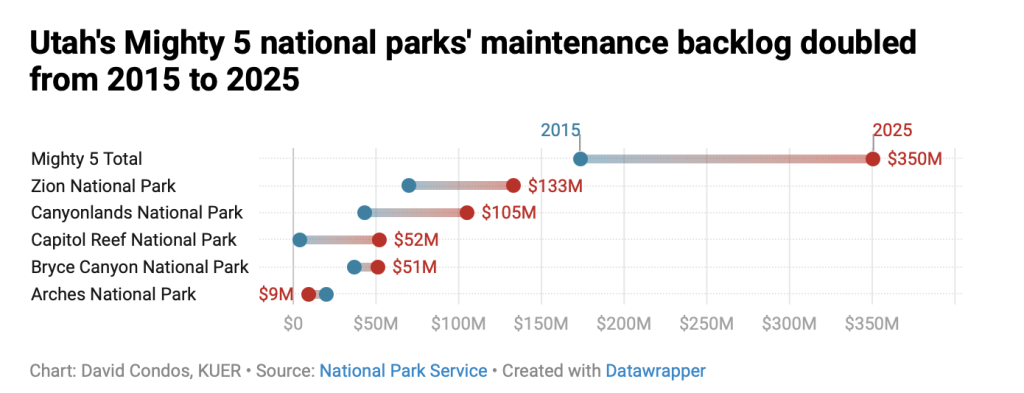
The maintenance backlog at Utah’s Mighty 5 national parks has more than doubled in the past decade.
It now exceeds $350 million — up from $173.8 million in 2015 — according to reports from the National Park Service.
When you factor in all the National Park Service sites wholly or partially in Utah — from Glen Canyon at Lake Powell to Timpanogos Cave — the increase is even larger. The backlog for those combined parks jumped 123% from 2015 to 2025. It stands at $828.3 million.
The totals reflect how much it would cost to address what the park service calls deferred maintenance and repairs — such as fixing roads, trails or water systems that may have been pushed off for years because of budget constraints. It does not include upgrades or expansions, but only the “correction of existing deficiencies.”
Emily Thompson, executive director with the advocacy group Coalition to Protect America’s National Parks, compares the situation to a home with an aging roof. If you’re losing a few shingles here and there but keep putting off repairs, the roof will someday fail.
“Then not only do you have to fix the roof, you have to fix all of the rooms that have been damaged,” Thompson said. “So, pushing this off and kicking these projects down the road — we’re going to pay the price for that eventually.”
The growing backlog is not a new problem, and it’s not unique to Utah. The nationwide total has also doubled in the past decade, from less than $12 billion to $24 billion. For context, the National Park Service’s latest annual budget was a little over $3 billion.
And Thompson is concerned that some recent actions from the Trump administration may be making a difficult situation worse.
The Associated Press reported in August that the administration relegated around 1,500 approved maintenance projects at parks nationwide to a “low priority” list. Other projects in Washington, D.C., including those associated with Trump’s Freedom 250 initiative and the botched reflecting pool repair, took precedence.
National park sites in Washington, D.C. certainly have maintenance needs, Thompson said, and the park service has always had to prioritize some projects over others. But what’s unusual, she said, is the large amount of money now flowing to the nation’s capital.
“There’s a lot of money that comes through from visitor entrance fees at parks across the country, and visitors expect some of that money to benefit the parks that they’re in,” Thompson said. “And we have seen that pretty large percentages of that money has also been shifted to D.C. to tackle some of these vanity projects.”
A separate report from The Washington Post in September found the Trump administration has also blocked around $25 million for more than 130 projects at parks nationwide, including Utah’s Zion. The projects had already secured federal funding but appear to have been nixed because the administration did not approve of the outside organizations that would help parks carry out the work.
“At a time when the National Park Service is already stretched — they’re stretched in staffing, budgets are low,” Thompson said. “This is just kind of an additional hit.”
The National Park Service estimates Zion alone would need $133 million to tackle the infrastructure projects it’s had to put off. That includes $72 million to care for roads and $17 million each for buildings and trails. Even Zion’s smaller needs come with big price tags, such as $4.4 million for water systems and $4 million for employee housing.
Zion’s estimated annual budget is only around $10 million, and nearly all of that is eaten up by annual routine maintenance to keep facilities open and visitors safe.
It’s typical to see a park’s annual budget go primarily to routine work, said Mike Pflaum, president of the nongovernmental organization Association of National Park Rangers. He retired from the park service in 2021 after four decades as a ranger and supervisor at parks such as Yellowstone and Mount Rushmore.
He said that makes it challenging to keep other projects off the deferred list.
“Every year that goes by without making progress, those numbers grow because whatever is causing the deferred maintenance — with aging and weather and so forth — continues on,” Pflaum said.
That’s a problem, especially as park visitation has skyrocketed in recent years. Visitors may not immediately notice the consequence of delaying that work, Pflaum said, but they will eventually.
“It might be in a dramatic fashion — with a major road failure, landslide, something like that — or it can just be sort of the slow erosion of what I call ‘the National Park Service polish,’” he said. “And it just doesn’t seem like a way that a nation wants to keep its finest places.”
The Trump administration’s actions have slowed parks’ progress as they chip away at their maintenance backlogs, he said, but he’s hopeful the policies are temporary.
Keeping up with park maintenance not only protects the natural and historical resources of the sites, but it also provides an economic boost for nearby communities. Federal data shows national park visitation benefited Utah to the tune of $3.1 billion in 2024.
In Thompson’s view, the latest actions are just another example of how the administration has targeted national parks. That list now includes mass firings of park staff, efforts to erase history and science from park signage and proclamations to slash the sizes of Grand Staircase-Escalante and Bears Earsnational monuments. Her organization estimates that the park service has lost around a quarter of its permanent workforce since Trump’s second term began in 2025.
Even if the latest actions related to maintenance money end up being short-term policies, she said, in the long term they can jeopardize the protection of park landscapes and harm Utah communities.
“The sum total of all this adds up to a system that’s in crisis and under attack,” Thompson said. “And it’s something that is just hard to understand, I think, because Americans love their national parks.”