

ELECTRONIC TRANSMISSION – NO HARD COPY TO FOLLOW
Submitted via: https://eplanning.blm.gov/eplanning-ui/project/2035530/595/8021055/comment
April 22, 2025
Bureau of Land Management
Montana/Dakotas State Office
Branch of Fluid Minerals
Attention: Hattie Payne
5001 Southgate Drive
Billings, MT 59101
Subject: Comments on Draft Environmental Assessment and Finding of No Significant Impact for the BLM Montana-Dakotas 2025 Third Quarter (September) Oil and Gas Lease Sale (DOI-BLM-MT-0000-2025-0001-EA)
To whom it may concern:
I am writing on behalf of the Coalition to Protect America’s National Parks (Coalition), which represents over 4,000 current, former, and retired employees and volunteers of the National Park Service. Collectively, our membership represents over 50,000 years of national park management and stewardship experience. Our members include former National Park Service directors, deputy directors, regional directors, and park superintendents, as well as a variety of program specialists and field staff. Recognized as the Voices of Experience, the Coalition educates, speaks, and acts for the preservation and protection of the National Park System, and mission-related programs of the National Park Service (NPS).
We appreciate the opportunity to submit these comments on the Draft Environmental Assessment (Draft EA) and Draft Finding of No Significant Impact (Draft FONSI) analyzing 29 parcels covering 9,101.65 acres under consideration for potential oil and gas exploration and development for the Bureau of Land Management’s (BLM’s) Montana-Dakotas 2025 Third Quarter (September) Oil and Gas Lease Sale. As the BLM prepares for this lease sale and evaluates which parcels to offer for lease, the agency must continue to abide by its obligations under the law and existing policy, including the Fluid Mineral Leases and Leasing Process Rule (Leasing Rule)[1], which implements program reforms and provisions in the Inflation Reduction Act. In carrying out this lease sale, the BLM must comply with all applicable federal, state, and local laws and regulations.
I. Introduction
In our scoping comments[2], we emphasized the need for the BLM to consider deferring on leasing at least 3 parcels from this sale (parcels ND-2025-09-6880, 6879, and 0778), all of which border or are in close proximity to Theodore Roosevelt National Park (TRNP). We provided documented evidence for why oil and gas development is not compatible with the special recreational, historical, wilderness, and wildlife habitat resources and values that TRNP has to offer. In addition, we identified specific conservation and multiple use conflicts and potential environmental impacts associated with the proposed lease parcels that the BLM is obligated to analyze under applicable law.
However, in preparing the Draft EA and Draft FONSI for this sale the BLM has failed to consider deferring these three parcels, as well as failed to adequately disclose or analyze the potential impacts of leasing the proposed parcels on TRNP’s protected resources and values. The Draft EA’s brief discussion of the potential impacts of leasing proposed parcels near TRNP focuses primarily on impacts to “recreation” and does not take into consideration potential impacts to a variety of other fundamental resources and values at TRNP. Instead of preparing a meaningful analysis of potential impacts to the national park, BLM relies on application of a standard Controlled Surface Use (CSU) stipulation for NPS units at the leasing stage and would punt additional analysis to the APD stage.
As background, the 2014 Foundation Document[3] (Document) for TRNP identifies oil and gas development surrounding the park as TRNP’s “most significant parkwide issue” and states that “[s]pecifically, protecting wilderness values is central to the purpose of the park and is a reflection of the conservation ethic advocated by [Theodore] Roosevelt.”(Emphasis added) Given the well-established concerns about the proliferation of oil and gas development near the park and the NPS management emphasis on protecting the park’s landscape setting and wilderness values, the BLM has failed to meet its obligations under the National Environmental Policy Act (NEPA) and the Federal Land Policy and Management Act (FLPMA) in preparing the Draft EA for this sale. In addition, the BLM has neglected to consider a reasonable modified leasing alternative that would defer some of the proposed parcels, notably those parcels where leasing poses a significant threat to the special recreational, historical, wilderness, and wildlife habitat resources present within TRNP.
For these reasons, we believe that the BLM must defer the following parcels until such time that the bureau has properly and fully assessed the potential impacts of leasing the lands for oil and gas development:
- ND-2025-09-0778
- ND-2025-09-6879
- ND-2025-09-6880
II. The BLM has ample authority to defer lease parcels proposed for this sale.
The BLM is not mandated to lease any particular parcel for oil and gas development and production. Under the Mineral Leasing Act (MLA), lands “known or believed to contain oil or gas deposits may be leased” by the Interior Department. 30 U.S.C. § 226(a) (emphasis added). If DOI chooses to lease lands, sales are held only “where eligible lands are available.” Id. § 226(b)(1)(A) (emphasis added). For nearly a century, the U.S. Supreme Court and federal circuit courts have consistently recognized this “broad” and “considerable discretion” over the federal onshore leasing program.[4]
Where conflicts with other uses exist, as it does in this case, the BLM must analyze the deferral of lease parcels. The MLA does not contravene the resource conservation requirements of the Federal Land Policy and Management Act (FLPMA). 43 U.S.C. Ch. 35.Lands merely being designated as “open” for leasing under a particular BLM Resource Management Plan (RMP) does not mean the BLM is required to lease them. Under FLPMA, the BLM must manage public lands according to “multiple use” and “sustained yield” and “in a manner that will protect the quality of scientific, scenic, historical, ecological, environmental, air and atmospheric, water resources, and archeological values.” 43 U.S.C. §§ 1701(a)(7) & (8), 1712(c)(1), 1732(a). Multiple use obligates the agency to make the “most judicious use” of public lands and their resources to “best meet the present and future needs of the American people.” Id. § 1702(c). This requires taking “into account the long-term needs of future generations,” ensuring “harmonious and coordinated management of the various resources without permanent impairment of the productivity of the land and the quality of the environment.” Id. Sustained yield mandates “achiev[ing] and maint[aining] in perpetuity . . . a high-level annual or regular periodic output of the various renewable resources of the public lands consistent with multiple use.” Id. § 1702(h) (emphasis added). The BLM must “take any action necessary to prevent unnecessary and undue degradation of the lands.” Id. § 1732(b). “It is past doubt that the principle of multiple use does not require BLM to prioritize development over other uses. . . . Development is a possible use, which BLM must weigh against other possible uses including conservation to protect environmental values. . . .” New Mexico ex rel. Richardson v. BLM, 565 F.3d 683, 710 (10th Cir. 2009) (emphasis added).
The BLM is therefore not obligated to lease any specific parcel of public land for oil and gas development. The agency retains the authority to defer any or all lease sale parcels, even after bidding has concluded.[5] Moreover, where conflicts with other uses exist, the agency must affirmatively evaluate deferral of parcels in its alternatives analysis under the National Environmental Policy Act (NEPA). 43 U.S.C. Chapter 55.
III. The Draft EA and Draft FONSI fail to properly disclose or analyze the environmental effects of leasing.
The BLM must disclose and evaluate the environmental impacts of this proposed lease sale under NEPA. See e.g., 42 U.S.C. §§ 4331–4347. NEPA fosters informed decision making by federal agencies and promotes informed public participation in government decisions. See Balt. Gas & Elec. Co. v. NRDC, 462 U.S. 87, 97 (1983). To meet those goals, NEPA requires that the BLM “consider every significant aspect of the environmental impact of a proposed action” and inform the public of those impacts. Id. (internal citation omitted); accord Vermont Yankee Nuclear Power Corp. v. Natural Resources Defense Council, Inc., 435 U.S. 519, 553 (1978).[6] The BLM must take a “hard look” at the environmental effects before making any leasing decisions, ensuring “that the agency, in reaching its decision, will have available, and will carefully consider, detailed information concerning significant environmental impacts.” Robertson v. Methow Valley Citizens Council, 490 U.S. 332, 349–50 (1989). Environmental “[e]ffects are reasonably foreseeable if they are sufficiently likely to occur that a person of ordinary prudence would take [them] into account in reaching a decision.” Sierra Club v. Fed. Energy Regulatory Comm’n, 867 F.3d 1357, 1371 (D.C. Cir. 2017) (internal quotation omitted).
As a result, the BLM must address the failure of the Draft EA and Draft FONSI to properly disclose and analyze site-specific resource conflicts and the environmental effects discussed below.
a. The Draft EA fails to properly analyze lease parcels that are adjacent to or in close proximity to Theodore Roosevelt National Park (TRNP).
This lease sale includes parcels that border or are in close proximity to TRNP. Yet, the Draft EA fails to properly disclose or analyze potential adverse effects of leasing these parcels on TRNP’s special recreational, historical, wilderness, and wildlife habitat resources and values; and fails to defer or consider deferring these parcels.
Established as Theodore Roosevelt National Memorial Park[7] by act of Congress in 1947, the site preserves the landscape that inspired Theodore Roosevelt to adopt a conservation ethic. As president, he set aside more than 230 million acres of public land for future generations. In 1978, the area was given national park status when President Carter signed Public Law 95-625 that changed the memorial park to Theodore Roosevelt National Park (TRNP). This same law placed 29,920 acres[8] of the park under the National Wilderness Preservation System.
Concerns about the potential impacts of oil and gas development near TRNP are well documented. For example, the previously mentioned 2014 Foundation Document (Document)[9] prepared for TRNP under NPS planning guidelines identifies oil and gas development surrounding the park as TRNP’s “most significant parkwide issue.” The Document also identifies the park’s “fundamental resources and values” that are essential to protect. These include “[t]he park’s clean air, dark night skies, and dramatic terrain offer visitors sweeping views of unspoiled nature—the same unspoiled landscape that inspired Theodore Roosevelt. The protection of these resources is supported by the park’s designation as a Class I area under the Clean Air Act.”[10] In addition, “[p]rotecting wilderness values is central to the purpose of the park and is a reflection of the conservation ethic advocated by Roosevelt… In addition to the designated wilderness, the park’s remote setting, natural soundscape, and rugged topography create a sense of solitude for visitors throughout the park’s three units.”[11]
As context, 75 percent of the lands available for leasing in the Little Missouri National Grassland that borders TRNP on all sides have already been leased for oil and gas development.[12] The Foundation Document repeatedly identifies “oil development on private, state, and federal lands around the park” as a significant threat to park resources and values. Specific impacts of concern identified in the Document[13] include the following:
-
- Direct and indirect impacts on park resources and the visitor experience during seismic, drilling, and production activities, which include air emissions, increased noise, night sky degradation, and operations intruding upon the viewshed. Oil and gas wells, storage tanks, drill rigs, flares, and related infrastructure located outside park boundaries are visible from all three TRNP units. Pump jack noise and diesel generators threaten the wilderness character of the Theodore Roosevelt Wilderness as well as the quiet and chance for solitude in other areas of the park such as the Elkhorn Ranch.
- Socioeconomic impacts on the park and surrounding communities from rapidly expanding oil extraction in the region, which include rapid development of rural and agricultural areas, increased semi-truck traffic on local roads, increased crime, increased costs for housing, goods, and services, strain on infrastructure such as storm and wastewater systems, and additional impacts to soil, water, and air resources that affect areas adjacent to all three of the TRNP’s units and its gateway communities.
- Direct and indirect impacts on park resources and the visitor experience during seismic, drilling, and production activities, which include air emissions, increased noise, night sky degradation, and operations intruding upon the viewshed. Oil and gas wells, storage tanks, drill rigs, flares, and related infrastructure located outside park boundaries are visible from all three TRNP units. Pump jack noise and diesel generators threaten the wilderness character of the Theodore Roosevelt Wilderness as well as the quiet and chance for solitude in other areas of the park such as the Elkhorn Ranch.
In addition to the many concerns expressed in the Foundation Document, a 2017 study[14] prepared on behalf of the NPS found that “the damaging effects of [encroaching oil and gas development] on viewscapes, soundscapes, and air quality” contrast with the “solitude, quiet, and isolation of the prairie, the sense of vast openness, and the experience of black, starlit night” that characterize the park. NPS has also previously described development taking place around the park as “widespread,” “severe” and “the most significant parkwide issue.”
Given the sensitive and unique resources and values present within TRNP, it is imperative that the BLM disclose and analyze the impacts of the proposed leasing and development on adjacent park lands, including a meaningful cumulative effects analysis of how drilling on the proposed parcels would add to the degradation and other impacts from existing development as noted above. Where conflicts with other uses exist, the bureau must also affirmatively evaluate deferral of parcels in its alternatives analysis under NEPA. The BLM cannot merely “respond to industry expressions of interest… in leasing specific land parcels,” but rather it must undertake “independent agency determinations of which parcels to offer for oil and gas leases.” Wilderness Soc’y v. U.S. Dep’t of the Interior, No. 22-cv-1871 (CRC), 2024 U.S. Dist. LEXIS 51011, at *69 (D.D.C. Mar. 22, 2024). Yet, with regard to parcels ND-2025-09-6879 and 6880, the BLM has simply applied relatively minimal stipulations in order to “mitigate impacts” and “protect features critical to the visitor experience such as viewsheds, soundscapes, night skies, and air quality of National Park Service Units.” Without conducting site-specific analysis of these lands, the BLM has no basis for concluding that such stipulations will be adequate to mitigate all significant impacts on TRNP.
For example, Controlled Surface Use (CSU) stipulation #12-83 has been applied to surface disturbing activities and construction of semi-permanent and permanent facilities within 3 miles of the boundary of TRNP.[15] In contrast, there have not been similar mitigating measures provided for parcel ND-2025-09-0778, which is less than 8 miles from the Elkhorn Ranch Unit of the park. The Elkhorn Ranch Unit preserves the place President Roosevelt selected to be his “home ranch” after the deaths of his wife and mother. Oil and gas development in proximity to this area of the park poses a significant threat to its solemn nature and the peaceful visitor experience.
Along with historical and recreation resources, parcels ND-2025-09-0778, 6879, and 6880 all overlap important habitat for big game. According to the latest data available from the North Dakota Game and Fish Department, parcel ND-2025-09-0778 overlaps lands that host high use fawning and foraging areas for pronghorn, fawning and foraging areas for mule deer, and isolated primary range for elk. Parcels ND-2025-09-6879 and 6880 overlap lands that host fawning and foraging areas for mule deer, isolated primary range for elk, and critical range for bighorn sheep. These ungulate species have fragile populations in TRNP.
While the Draft EA recognizes the presence of big game birthing areas within parcels ND-2025-09-6879 and 6880 and the presence of bighorn sheep winter range within parcel ND-2025-09-6880[16], it does not recognize the big game birthing areas that overlap with parcel ND-2025-09-0778. And while the Draft EA considers effects to pronghorn winter range and migration routes from road density and oil and gas well pad density for the proposed lease parcels in Rosebud County, Montana, the BLM has simply applied basic RMP stipulations for the North Dakota parcels without providing any additional analysis.[17]
Pursuant to its own regulations, the BLM must give preference for leasing to: “lands that would not impair the proper functioning of [fish and wildlife] habitats or corridors” 43 C.F.R. § 3120.32(b); “lands that would not impair the cultural significance of [historic properties, sacred sites, or other high value cultural resources]” 43 C.F.R. § 3120.32(c); and “lands that would not impair the value of [recreation and other important] uses or resources” 43 C.F.R. § 3120.32(d). While the Draft EA identifies parcels ND-2025-09-0778 and 6880 as having low preference for leasing based on “proximity to habitat” and “other important uses or resources” criteria, parcel 6879 is identified in the Lease Preference Screening as having “high preference” for leasing based on all criteria.[18] Nonetheless, all three parcels have been designated as having high preference for leasing overall.
Another concern is that the Draft EA attempts to punt all “site-specific” analysis to the permitting stage. See Draft EA at 18 (“Conditions at the time an APD is submitted will be assessed for significance; the need for additional mitigation will also be determined at the time development is proposed. All future projects will under-go site-specific review…”). Furthermore, federal courts have repeatedly rejected agency claims that analysis at the lease sale stage would be speculative. See, e.g., Northern Plains Res. Council, Inc. v. Surface Transportation Board, 668 F.3d 1067, 1078–79 (9th Cir. 2011) (“Because speculation is implicit in NEPA, we must reject any attempt by agencies to shirk their responsibilities under NEPA labeling any and all discussion of future environmental effects as crystal ball inquiry.” (quotations and alternations omitted)). The BLM “cannot escape” proper analysis at the leasing stage “by claiming that a more precise analysis is not feasible and promising a more probing review of the site-specific effects at the APD stage.” Wilderness Soc’y, No. 22-cv-1871 (CRC), 2024 U.S. Dist. LEXIS 51011, at *61 (quotation marks omitted). Because leasing is an irreversible and irretrievable commitment of resources, the BLM may not defer detailed analysis until the permitting stage.
Without full consideration of the impacts of leasing and development on these parcels on TRNP’s protected recreational, historical, wilderness, and wildlife habitat resources, the BLM cannot make an informed decision on whether to defer the aforementioned parcels. Because the agency has failed to analyze these impacts in the Draft EA, designation of parcels proposed for lease that are adjacent and in close proximity to TRNP as having a high preference for lease is unfounded. Until full analysis is complete, the BLM must defer parcels ND-2025-09-0778, 6879, and 6880 from oil and gas leasing.
b. Given that parcels ND-2025-09-6880 and ND-2025-09-6879 are adjacent to the Theodore Roosevelt Wilderness Area in the North Unit of TRNP, we are particularly concerned that the Draft EA does not analyze potential impacts to wilderness.
The Wilderness Act of 1964 (P.L. 88–577) established the National Wilderness Preservation System and provides the highest level of protection for some of our most wild landscapes through federal wilderness designation. The NWPS protects over 111 million acres of federal public land through wilderness designation, managed by the National Park Service (NPS), Bureau of Land Management (BLM), US Fish and Wildlife Service, and US Forest Service.[19]
Despite the significant level of protection conveyed by Congress to the federally designated Theodore Roosevelt Wilderness Area within TRNP, the BLM has not disclosed or analyzed potential impacts of leasing two parcels immediately adjacent to the park’s wilderness boundary. As stated in Table 2.1 of the Draft EA, the BLM “considered but did not analyze” potential impacts to wilderness. In effect, the absence of any analysis of wilderness impacts in the Draft EA applies to: 1) Parcel ND-2025-09-6880 (673 acres), which abuts the southern boundary of the Theodore Roosevelt Wilderness Area in the North Unit of the park; and 2) Parcel ND-2025-09-6879 (39 acres), which abuts the eastern portion of parcel 6880 and is located within 1 mile of the wilderness boundary. See map below. Foreseeable potential impacts to the wilderness area include impacts to the viewshed, soundscape, night skies, and air quality; yet the Draft EA neither discloses nor analyzes these potential impacts.
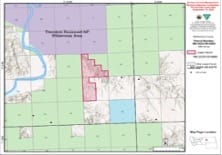
Map is from Appendix C, p. 34, of Draft EA, with text added to identify “Theodore Roosevelt NP Wilderness Area” and Parcel “ND-2025-09-6879.”
In contrast to the relative lack of analysis of potential impacts to TRNP in the Draft EA, we call your attention to DOI-BLM-MT-C030-2017-0133-EA[20], which disclosed and analyzed potential environmental consequences of leasing 1 nominated lease parcel (120 acres) abutting the northern wilderness boundary of the North Unit of TRNP for a proposed March 2018 lease sale. References to TRNP in that EA included the following sections:
-
- Section 3.1 of the EA included an objective to “Ensure that the high visual qualities of the National Park Service Units are considered in cooperation with the NPS when a specified mineral lease or developmental action is proposed that potentially affects existing visual qualities.”
- Under Section 3.17 Special Designations, section 3.17.1 identified TRNP as a specially designated area in the project area and describes the nexus of the park to the proposed lease sale.
- Section 4.3.11 Visual Resources, disclosed that “the proposed action may be within line-of-sight from points within Theodore Roosevelt National Park. Development may cause potential impacts to the National Park and visitors. Impacts could include reduction or alteration of current viewsheds and dark night skies.”
- Section 4.3.16 Special Designations Theodore Roosevelt National Park disclosed that “[f] future oil and gas development and production may potentially impact Theodore Roosevelt National Park and its visitors. Impacts could include reduction of current viewsheds, dark night skies, and soundscape.”
Based, in part, on such information, the BLM ultimately decided:
“to defer the one nominated lease parcel for the North Dakota March 2018 Lease Sale, and to withdraw from analysis the associated EA (Environmental Assessment). Due to time needed to thoroughly consider the comments on the EA (before the required posting dates for the lease sale process), and time needed for any potential additional analysis required to respond to comments, this parcel is being deferred.” [21]
Compared to the 2018 EA, which resulted in the parcel near TRNP being deferred, the 2025 Draft EA:
- Contains no stated objective to protect “the high visual qualities” at TRNP;
- Contains no section(s) on areas with Special Designations, such a national park units including TRNP;
- Fails to acknowledge concerns about potential impacts if BLM were to allow drilling in close proximity to TRNP; and
- Fails to disclose that “[f] future oil and gas development and production [on the parcels adjacent to the park] may potentially impact Theodore Roosevelt National Park and its visitors. Impacts could include reduction of current viewsheds, dark night skies, and soundscape.”[22]
Compared to the 120-acre parcel that was deferred during the March 2018 lease sale, currently proposed lease parcels ND-2025-09-6880 and 6879 involve a total of 712 acres combined, with parcel 6880 abutting the TRNP wilderness boundary and parcel 6879 being located 1 mile from the wilderness boundary. Since these two parcels equal nearly 6X more acreage than the 2018 proposal, the potential for the 2025 lease sale to cause adverse impacts on park resources and values, including wilderness character, is likely greater as well. Given the greater potential for adverse impacts from the September 2025 lease sale (compared to the March 2018 proposed lease sale) and the fact that the current Draft EA has neither disclosed nor analyzed those impacts, the Draft EA appears to be deficient and defective on its face.
Lastly, we note that in a limited number of cases Congress has enacted wilderness legislation that includes a specific provision that “adjacent multiple use lands are not to be managed to provide buffer zones around wilderness areas” (e.g., the Wyoming Wilderness Act of 1984). However, there was no such provision in the National Parks and Recreation Act of 1978[23] (PL 95-625, Section 401), which designated the Theodore Roosevelt Wilderness. As a result, the BLM must properly disclose and analyze potential impacts of leasing these parcels adjacent to the NPS-managed wilderness area. And similar to BLM’s 2018 decision to defer leasing a parcel adjacent to the park wilderness boundary, it would be reasonable and prudent for the BLM to similarly defer on leasing parcels in close proximity to TRNP for the September 2025 lease sale.
c. The BLM must consider a range of reasonable alternatives.
The Draft EA considers only two alternatives: the no action alternative and the full-leasing alternative. Failure to analyze a reasonable, modified leasing alternative, which considers deferral of one or more parcels based on the discussion above and based on the recommendations we previously provided in scoping comments is a violation of NEPA. For years, the BLM has included such a modified leasing, or deferral, alternative in its lease sale NEPA analyses. It must do so for this lease sale.
Under NEPA, the BLM must evaluate a range of reasonable alternatives. The range of alternatives is the heart of a NEPA document because “[w]ithout substantive, comparative environmental impact information regarding other possible courses of action, the ability of [a NEPA analysis] to inform agency deliberation and facilitate public involvement would be greatly degraded.” New Mexico ex rel. Richardson, 565 F.3d at 683, 708. NEPA analysis must cover a reasonable range of alternatives so that an agency can make an informed choice from the spectrum of reasonable options. An environmental review offering a choice between leasing every parcel nominated and leasing nothing at all under the no-action alternative fails to present a reasonable range of alternatives. A middle-ground alternative should consider deferring at least some parcels. Such an alternative is particularly important when considering impacts to protected resources and values at TRNP.
In sum, it would be entirely appropriate for the BLM to evaluate an alternative that would defer leasing parcels adjacent and in close proximity to TRNP. As discussed above, deferring parcels that present such significant conflicts on such sensitive lands—and certainly parcels that the BLM itself identifies to have low preference for leasing based on the presence of habitat and recreation resources designates as having low preference for leasing—is precisely what the Leasing Rule contemplates.
Evaluating such an alternative is also necessary to fulfill the “absolute duty” that the Secretary of the Interior and therefore the Department and its bureaus such as the BLM have to protect national park resources and values from BLM-managed activities on public lands adjacent to TRNP. As described in NPS Management Policies 2006, under the 1978 Redwood amendment to the NPS General Authorities Act of 1970 Congress has declared that “the Secretary has an absolute duty, which is not to be compromised…to take whatever actions and seek whatever relief as will safeguard the units of the national park system.”[24] It is additionally described in the NPS Management Policies that “Congress, recognizing that the enjoyment by future generations of the national parks can be ensured only if the superb quality of park resources and values is left unimpaired, has provided that when there is a conflict between conserving resources and values and providing for enjoyment of them, conservation is to be predominant.”[25] It follows, therefore, that it has been a longstanding opinion of the DOI Office of the Solicitor that “the Secretary of the Interior has the legal authority to reject the applications for mineral exploration if the record supports a finding that mineral development activities that might eventually follow exploration could be detrimental to the resources or values of a [national] park unit.”[26]
Finally, as we raised in our scoping comments and earlier in this letter, considering an alternative that would defer these parcels would be consistent with the North Dakota Field Office’s March 2018 lease sale decision to defer a parcel adjacent to the North Unit of TRNP due, in part, to concerns about impacts to park resources.
IV. Because the Draft FONSI is based on a fundamentally flawed Draft EA, the Draft FONSI is defective as well.
As described above, the Draft EA fails to disclose or analyze potential adverse impacts on park resources and values of leasing the proposed lease parcels in close proximity to TRNP, including the two parcels either abutting or within 1 mile of the boundary of the Theodore Roosevelt Wilderness Area. The Draft EA notably “considered but did not analyze” potential impacts to wilderness (see Table 2.1), despite the fact that parcels 6880 and 6879 are in close proximity to the park’s wilderness boundary. Under similar circumstances (involving proposed leasing of a parcel abutting the same wilderness area in TRNP), a 2018 EA prepared by BLM disclosed and analyzed potential adverse impacts of the proposed leasing; and the BLM ultimately decided to defer leasing that parcel. In contrast, the 2025 Draft EA provides no such disclosures or analyses; and, as a result, the Draft EA is defective on its face. If the BLM were to issue a FONSI/decision document based on the defective Draft EA, then the FONSI would be defective as well.
V. Closing Comments.
If the BLM decides to proceed with leasing the parcels in close proximity to TRNP despite these concerns, we ask that you explain in the final EA and FONSI why you have decided to do so in spite of the similarities to March 2018 lease sale which resulted in the prudent decision to defer leasing a parcel located along the TRNP wilderness boundary. The similarities between the 2018 and 2025 proposed lease sales are readily apparent. However, if drilling operations were to be allowed on parcels in close proximity or adjacent to TRNP this time, the stark contrast in the outcomes between the 2018 and 2025 decisions would seem to be arbitrary and capricious.
In closing, we appreciate the opportunity to comment ton this important issue.
Sincerely,
Philip A. Francis, Jr.
Chair of the Executive Council
Coalition to Protect America’s National Parks
2 Massachusetts Ave NE, Unit 77436, Washington, DC 20013
cc: Jon Raby, Acting Director, Bureau of Land Management
[4] See Udall v. Tallman, 380 U.S. 1, 4 (1965) (“The Mineral Leasing Act [MLA] of 1920 . . . left the Secretary discretion to refuse to issue any lease at all on a given tract.”); United States ex rel. McLennan v. Wilbur, 283 U.S. 414, 419 (1931) (ruling that the Interior Secretary possesses “general powers over the public lands as guardian of the people,” which include the authority to deny oil and gas lease applications); Mont. Wildlife Fed’n v. Haaland, 127 F.4th 1, 44–45 (9th Cir. 2025) (“We note that there is no doubt that the government has the authority affirmatively to determine which parcels shall be offered for oil and gas leasing, as opposed to passively responding to expressions of interest.”); W. Energy Alliance v. Salazar, 709 F.3d 1040, 1044 (10th Cir. 2013) (“The MLA, as amended by the Reform Act of 1987, continues to vest the Secretary with considerable discretion to determine which lands will be leased.”); Bob Marshall Alliance v. Hodel, 852 F.2d 1223, 1230 (9th Cir. 1988) (“[T]he Mineral Leasing Act gives the Interior Secretary discretion to determine which lands are to be leased under the statute. . . . Thus refusing to issue the . . . leases . . . would constitute a legitimate exercise of the discretion granted to the Interior Secretary under that statute.”); McDonald v. Clark, 771 F.2d 460, 463 (10th Cir. 1985) (“It is clear that the Secretary has broad discretion in this area. While the statute gives the Secretary the authority to lease government lands under oil and gas leases, this power is discretionary rather than mandatory.”); Burglin v. Morton, 527 F.2d 486, 488 (9th Cir. 1975) (“The permissive word ‘may’ in Section 226(a) allows the Secretary to lease such lands, but does not require him to do so. Although Section 226(c) requires the Secretary to issue the lease to the first qualified applicant if the land is leased, the Secretary has discretion to refuse to issue any lease at all on a given tract.”).
[5] See McDonald v. Clark, 771 F.2d 460, 463 (10th Cir. 1985) (holding that the “fact that land has been offered for lease does not bind the Secretary to actually lease the land, nor is the Secretary bound to lease the land when a qualified applicant has been selected”); see also Justheim Petroleum v. Dep’t of Interior, 769 F.2d 668, 671 (10th Cir. 1985) (language in 30 U.S.C. § 226 mandating that “lands to be leased … shall be leased to the highest responsible qualified bidder” did not require issuing a lease, but only required awarding lease to that bidder “if [the Secretary] is going to lease at all”); Wyoming v. U.S. Dep’t of the Interior, No. 22-CV-247-SWS, 2024 U.S. Dist. LEXIS 235015, at *43 (D. Wyo. Dec. 31, 2024) (“When considering statutory language, the use of the word ‘may’ creates a presumption of discretion under normal rules of statutory interpretation, in contrast with the mandatory ‘shall.’” (cleaned up)); W. Energy All. v. Salazar, No. 10-cv-0226, 2011 U.S. Dist. LEXIS 98380, at *9–23 (D. Wyo. June 29, 2011) (holding that BLM is not required to issue leases after offering them at auction; it only needs to make a decision within 60 days on whether to issue the leases); 89 Fed. Reg. at 30,945 (“[T]he Secretary retains the discretion to decide, even after lands have been determined to be eligible and available, what lands will ultimately be offered for lease.”).
[6] See Kleppe v. Sierra Club, 427 U.S. 390, 410, 413 (1976); City of Rochester v. U.S. Postal Serv., 541 F.2d 967, 973–74 (2d Cir. 1976); Concerned About Trident v. Rumsfeld, 555 F.2d 817, 825 (D.C. Cir 1976); City of Davis v. Coleman, 521 F.2d 661, 666-677 (9th Cir. 1975); Brooks v. Coleman, 518 F.2d 17, 18 (9th Cir. 1975); Natural Resources Defense Council v. Callaway, 524 F.2d 79, 89 (2d Cir. 1975); Envtl. Def. Fund, Inc. v. Corps of Eng’rs of U.S. Army, 492 F.2d 1123, 1135 (5th Cir. 1974); Swain v. Brinegar, 517 F.2d 766 (7th Cir. 1975); Minnesota Public Interest Research Group v. Butz, 498 F.2d 1314, 1322 (8th Cir. 1974); Natural Resources Defense Council v. Morton, 458 F.2d 827, 834–36 (D.C. Cir. 1972); Hanly v. Kleindienst, 471 F.2d 823, 830-31 (2d Cir. 1972); Calvert Cliffs’ Coordinating Comm., Inc. v. U.S. Atomic Energy Comm’n, 449 F.2d 1109, 1114 (D.C. Cir. 1971).
[7] NPS, Theodore Roosevelt National Park History, available at https://nps.gov/thro/learn/historyculture/park-history.htm.
[8] NPS, Theodore Roosevelt National Park Acreage by Unit, available at https://home.nps.gov/thro/learn/management/park-acreage-by-unit.htm.
[9] https://www.nps.gov/thro/learn/management/upload/Theodore-Roosevelt-National-Park-Foundation-Document-2014.pdf, pp.8-9.
[10] See NPS, April 2014 Theodore Roosevelt National Park Foundation Document at 9, https://www.nps.gov/thro/learn/management/upload/Theodore-Roosevelt-National-Park-Foundation-Document-2014.pdf.
[11] Ibid.,at 9.
[12] See SDA, Northern Great Plains Management Plans Revision Draft Supplemental Environmental Impact Statement for Oil and Gas Leasing, available at https://www.fs.usda.gov/Internet/FSE_DOCUMENTS/fseprd1082964.pdf.
[13] See NPS, April 2014 Theodore Roosevelt National Park Foundation Document at 14, https://www.nps.gov/thro/learn/management/upload/Theodore-Roosevelt-National-Park-Foundation-Document-2014.pdf.
[14] NPS, January 2017 Theodore Roosevelt National Park, North Dakota Historic Resource Study, available at http://www.npshistory.com/publications/thro/hrs.pdf.
[15] See BLM, Environmental Assessment: Montana-Dakotas 2025 Third Quarter Competitive Lease Sale at Appendix B (2025).
[16] See BLM, Environmental Assessment: Montana-Dakotas 2025 Third Quarter Competitive Lease Sale at 85 (2025).
[17] Id.
[18] See BLM, Environmental Assessment: Montana-Dakotas 2025 Third Quarter Competitive Lease Sale at Appendix J (2025).
[19] https://www.nps.gov/articles/federal-wilderness.htm
[20]https://eplanning.blm.gov/public_projects/nepa/87486/121809/148670/NDFO_March_2018_Lease_Sale_EA.pdf
[21]https://eplanning.blm.gov/public_projects/nepa/87486/127800/155500/Withdrawn.pdf
[22] See pp. 64-65 at: https://eplanning.blm.gov/eplanning-ui/search?searchText=DOI-BLM-MT-C030-2017-0133-EA
[23] https://foresthistory.org/wp-content/uploads/2017/01/public-law-95-625.pdf
[24] NPS 2006 Management Policies, Section 1.4.2, https://www.nps.gov/orgs/1548/upload/ManagementPolicies2006.pdf.
[25] Id. at Section 1.4.3.
[26] See DOI Solicitor Opinion # M-36993,# which is commonly referred to as “the Doe Run opinion.”